Next: shelter medicine internship in Florida!
Tuesday, May 22, 2012
The Dog Zombie, DVM, MS!
Next: shelter medicine internship in Florida!
Sunday, May 6, 2012
The science and policy of contraception... in cats
[Reposted from the Scientific American Guest Blog on May 4th, 2012.]
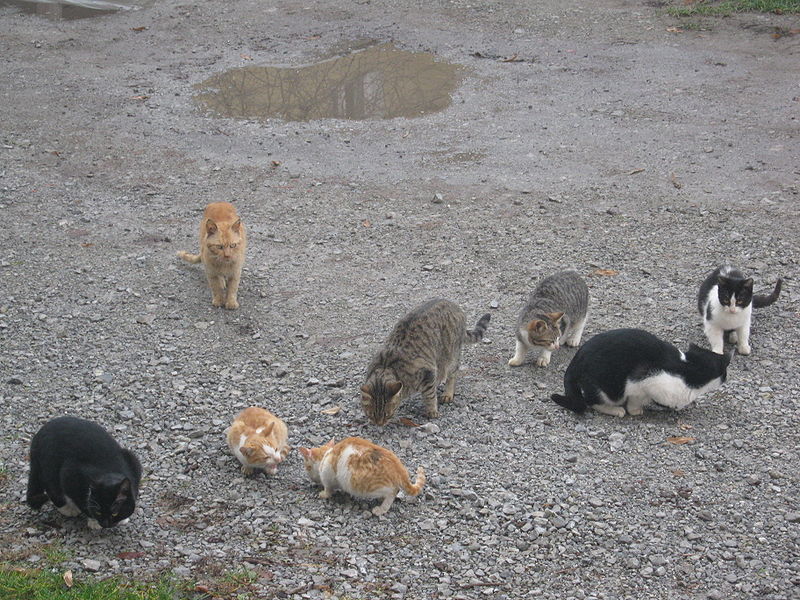
Sometimes when I come home from work there is a big orange cat sunning himself on my front porch. He ambles away as soon as he sees me – not a panicked dash, because he’s used to humans, but there is certainly no way I’d ever get close enough to pet him. No one owns this cat, although my next door neighbors sometimes feed him, and he clearly lives in the neighborhood; he and my dogs know each other well from high-volume interactions across the fence. He is a feral cat, sometimes known as a community cat. He probably lives in a small colony, and indeed there are several other individuals that I have seen around, although this is the only one who likes to sleep on my front step.
This orange cat seems to have a pretty good life, which is often true for cats living in colonies that are managed. This colony, as I’ve said, is at least getting fed regularly. However, his life is liable to be shorter than that of an owned cat, and in fact I have already taken two badly-injured community cats the local veterinary hospital for euthanasia. (As the neighborhood veterinary student I find that one of my responsibilities is dealing with cats who have been hit by cars or attacked by other animals.) He is also at risk of disease, such as feline leukemia or feline AIDS, because he has probably never been vaccinated. He is not the only one at risk; his colony may maintain a reservoir of these feline diseases which can then be transmitted into the population of owned cats who are allowed outside to interact with their feral cousins. Moreover, community cats are often sexually intact and certainly contribute to the overwhelming number of kittens that my community sees every spring and summer. And, of course, bird lovers complain of the depredations of community cats on the local wildlife.
Time was, people trapped community cats and euthanized them as a means of population control. This didn’t work as well as you might think, because when a colony of cats was depleted, new cats would move in to take their place. It turns out that maintaining a healthy colony keeps new cats out. In the last decade or so, volunteers and animal shelters have been implementing trap/neuter/return (TNR) programs. Cats are trapped and brought to veterinary clinics, where they are vaccinated and spayed or neutered. They are returned to their colonies, which are managed by caretakers. In this way, colonies are kept small but healthy.
However, TNR programs are maintained at great expense. Veterinary surgeons are not cheap, and even with volunteer veterinarians, a surgical suite also has to be acquired. Cats have to be trapped on a specific day when a TNR clinic is scheduled, not an easy task itself, transported to the clinic and then transported back. The expense slows down the process, and it’s not clear that we can spay and neuter fast enough to keep up with the population.
A simple medical intervention would be much more efficient than surgery. The ideal chemical contraceptive would be inexpensive to make and easy to administer; a single treatment would have a long term or even permanent effect; it would have a wide margin of safety for both cats and the environment (you wouldn’t want a dead cat to be full of some toxin that would endanger other animals); and it would have a rapid onset of action. Ideally, it would not just prevent litters, but would also reduce the nuisance behaviors associated with breeding, because cats having sex are extremely noisy. The contraceptive should be widely effective, although studies suggest that it only needs to affect 70-80% of female cats in order to achieve population reduction.
There are some possibilities already being studied. Both are vaccines – it’s an amusing idea to vaccinate against pregnancy, but of course vaccines do have a long term effect, so they're logical choices for this situation. One vaccination target is the zona pellucida. This is the coating around the egg which allows in one, and only one, sperm; vaccinated animals produce antibodies which attack the ZP and therefore inactivate the egg. The nice thing about ZP vaccination is that is is highly species-specific – the ZP is, in fact, part of the mechanism that keeps species from being able to interbreed with each other. Unfortunately, the ZP vaccine which is currently available was not developed specifically against cat ZP, and does not work well in cats. A cat-specific ZP has also been tested but, surprisingly, is not highly effective either. Perhaps more research will sort the problem out, but for now this is not a viable alternative. Additionally, as you might guess from the mechanism, ZP vaccination doesn’t affect mating behaviors even when it works; it only affects conception. So cats will still yowl during sex after ZP vaccination.
A more promising alternative is vaccination against GnRH, the master hormone of the sex hormones. Through minion hormones, GnRH controls production of sperm and ovulation of eggs. Unlike the ZP vaccine, the GnRH vaccine reduces both pregnancy and mating behaviors. Its effectiveness is somewhat unpredictable, so some vaccinated animals keep right on getting pregnant. Its length of effectiveness is also somewhat variable, but can last up to several years in some studies. Although your housecat might live into its late teens, several years of birth control are probably sufficient in shorter-lived community cats.
A commerical GnRH vaccine, GonaCon, is approved in cervids and has been successfully used in white-tailed deer. It has been tested in cats in laboratory settings, but not in the field. The idea is enticing: volunteers could trap cats, then vaccinate them with GonaCon and the usual array of anti-disease vaccines right in the trap, then release them, never having had to bring them in to a veterinary clinic. Efficiency would be hugely increased. Hopefully initial trials would show that GonaCon is effective at population reduction in cats, something that hasn’t yet been proven.
Real life is never so simple, of course. I talked about contraceptive vaccination with a few vet techs at an animal shelter recently. They loved the idea, but pointed out that in our state, once you are providing any medical care for a cat, such as contraception, you have to make sure they are vaccinated for rabies, which legally requires the presence of a veterinarian. Once you have to bring in a vet, of course, the expense starts going up again. We batted around some ideas – maybe you could distribute an oral form of a vaccine in bait form, and get around the rabies vaccination requirement by dint of never actually touching the cat. In this case, the ZP vaccine might be better, as it is more species-specific and presumably could be eaten by other species without effect, but of course the ZP vaccine requires more work before it will be effective in cats.
So chemical contraceptives for community cats aren’t quite ready for prime time, but there are some promising candidates. My suspicion is that the biggest problem is simply willingness on the part of society to commit the resources necessary to develop a workable solution. Cat rescuers and animal shelters, both with notorious money problems, can’t possibly represent attractive markets to drug companies. Who will fund the necessary research and the advocacy for policy changes that are necessary? You can stay up to date with news as the story unfolds at the Alliance for Contraception in Cats and Dogs. You can even donate to them. Community cats may be our responsibility, as domesticated animals gone feral, or they may not be, but either way they affect us and the animals we live with. Efficient and humane management of their populations benefits both them and us.
References
Sometimes when I come home from work there is a big orange cat sunning himself on my front porch. He ambles away as soon as he sees me – not a panicked dash, because he’s used to humans, but there is certainly no way I’d ever get close enough to pet him. No one owns this cat, although my next door neighbors sometimes feed him, and he clearly lives in the neighborhood; he and my dogs know each other well from high-volume interactions across the fence. He is a feral cat, sometimes known as a community cat. He probably lives in a small colony, and indeed there are several other individuals that I have seen around, although this is the only one who likes to sleep on my front step.
This orange cat seems to have a pretty good life, which is often true for cats living in colonies that are managed. This colony, as I’ve said, is at least getting fed regularly. However, his life is liable to be shorter than that of an owned cat, and in fact I have already taken two badly-injured community cats the local veterinary hospital for euthanasia. (As the neighborhood veterinary student I find that one of my responsibilities is dealing with cats who have been hit by cars or attacked by other animals.) He is also at risk of disease, such as feline leukemia or feline AIDS, because he has probably never been vaccinated. He is not the only one at risk; his colony may maintain a reservoir of these feline diseases which can then be transmitted into the population of owned cats who are allowed outside to interact with their feral cousins. Moreover, community cats are often sexually intact and certainly contribute to the overwhelming number of kittens that my community sees every spring and summer. And, of course, bird lovers complain of the depredations of community cats on the local wildlife.
Time was, people trapped community cats and euthanized them as a means of population control. This didn’t work as well as you might think, because when a colony of cats was depleted, new cats would move in to take their place. It turns out that maintaining a healthy colony keeps new cats out. In the last decade or so, volunteers and animal shelters have been implementing trap/neuter/return (TNR) programs. Cats are trapped and brought to veterinary clinics, where they are vaccinated and spayed or neutered. They are returned to their colonies, which are managed by caretakers. In this way, colonies are kept small but healthy.
However, TNR programs are maintained at great expense. Veterinary surgeons are not cheap, and even with volunteer veterinarians, a surgical suite also has to be acquired. Cats have to be trapped on a specific day when a TNR clinic is scheduled, not an easy task itself, transported to the clinic and then transported back. The expense slows down the process, and it’s not clear that we can spay and neuter fast enough to keep up with the population.
A simple medical intervention would be much more efficient than surgery. The ideal chemical contraceptive would be inexpensive to make and easy to administer; a single treatment would have a long term or even permanent effect; it would have a wide margin of safety for both cats and the environment (you wouldn’t want a dead cat to be full of some toxin that would endanger other animals); and it would have a rapid onset of action. Ideally, it would not just prevent litters, but would also reduce the nuisance behaviors associated with breeding, because cats having sex are extremely noisy. The contraceptive should be widely effective, although studies suggest that it only needs to affect 70-80% of female cats in order to achieve population reduction.
There are some possibilities already being studied. Both are vaccines – it’s an amusing idea to vaccinate against pregnancy, but of course vaccines do have a long term effect, so they're logical choices for this situation. One vaccination target is the zona pellucida. This is the coating around the egg which allows in one, and only one, sperm; vaccinated animals produce antibodies which attack the ZP and therefore inactivate the egg. The nice thing about ZP vaccination is that is is highly species-specific – the ZP is, in fact, part of the mechanism that keeps species from being able to interbreed with each other. Unfortunately, the ZP vaccine which is currently available was not developed specifically against cat ZP, and does not work well in cats. A cat-specific ZP has also been tested but, surprisingly, is not highly effective either. Perhaps more research will sort the problem out, but for now this is not a viable alternative. Additionally, as you might guess from the mechanism, ZP vaccination doesn’t affect mating behaviors even when it works; it only affects conception. So cats will still yowl during sex after ZP vaccination.
A more promising alternative is vaccination against GnRH, the master hormone of the sex hormones. Through minion hormones, GnRH controls production of sperm and ovulation of eggs. Unlike the ZP vaccine, the GnRH vaccine reduces both pregnancy and mating behaviors. Its effectiveness is somewhat unpredictable, so some vaccinated animals keep right on getting pregnant. Its length of effectiveness is also somewhat variable, but can last up to several years in some studies. Although your housecat might live into its late teens, several years of birth control are probably sufficient in shorter-lived community cats.
A commerical GnRH vaccine, GonaCon, is approved in cervids and has been successfully used in white-tailed deer. It has been tested in cats in laboratory settings, but not in the field. The idea is enticing: volunteers could trap cats, then vaccinate them with GonaCon and the usual array of anti-disease vaccines right in the trap, then release them, never having had to bring them in to a veterinary clinic. Efficiency would be hugely increased. Hopefully initial trials would show that GonaCon is effective at population reduction in cats, something that hasn’t yet been proven.
Real life is never so simple, of course. I talked about contraceptive vaccination with a few vet techs at an animal shelter recently. They loved the idea, but pointed out that in our state, once you are providing any medical care for a cat, such as contraception, you have to make sure they are vaccinated for rabies, which legally requires the presence of a veterinarian. Once you have to bring in a vet, of course, the expense starts going up again. We batted around some ideas – maybe you could distribute an oral form of a vaccine in bait form, and get around the rabies vaccination requirement by dint of never actually touching the cat. In this case, the ZP vaccine might be better, as it is more species-specific and presumably could be eaten by other species without effect, but of course the ZP vaccine requires more work before it will be effective in cats.
So chemical contraceptives for community cats aren’t quite ready for prime time, but there are some promising candidates. My suspicion is that the biggest problem is simply willingness on the part of society to commit the resources necessary to develop a workable solution. Cat rescuers and animal shelters, both with notorious money problems, can’t possibly represent attractive markets to drug companies. Who will fund the necessary research and the advocacy for policy changes that are necessary? You can stay up to date with news as the story unfolds at the Alliance for Contraception in Cats and Dogs. You can even donate to them. Community cats may be our responsibility, as domesticated animals gone feral, or they may not be, but either way they affect us and the animals we live with. Efficient and humane management of their populations benefits both them and us.
References
- Levy, J.K. (2011). Contraceptive Vaccines for the Humane Control of Community Cat Populations, American Journal of Reproductive Immunology, 66 (1) 70. DOI: 10.1111/j.1600-0897.2011.01005.x
- Levy, J.K., Friary, J.A., Miller, L.A., Tucker, S.J. & Fagerstone, K.A. (2011). Long-term fertility control in female cats with GonaCon™, a GnRH immunocontraceptive, Theriogenology, 76 (8) 1525. DOI: 10.1016/j.theriogenology.2011.06.022
- Alliance for Contraception in Cats and Dogs
Sunday, April 22, 2012
Book Review: Plenty in Life is Free
I just finished Plenty in Life is Free: reflections on dogs, training and finding grace, by Kathy Sdao. It was revelatory. It is funny to say that I had trouble putting down a dog training book, but I did (I put off email and sleep to finish it). It’s a short book, but truly lovely. The two Sdao seminars I’ve attended have both stuck with me years later and informed my training, and Sdao is as engaging and thoughtful an author as she is a speaker.
This book seems to be written for an audience of dog trainers, but it has plenty in it to appeal to the dog owner as well. Don’t expect it to walk you through how to train your dog to sit, or to provide details on how to handle a new puppy or to turn around dog-dog aggression. It’s really a philosophy book about how to approach dog training: we don’t have to control our dog’s every move and obsess about leadership. We can be our dog’s parents, protecting and guiding but leaving them a reasonable amount of independence too.
Sdao discusses the concept of “sticky stories,” stories that stick in people’s minds, such as the story that dogs evolved from wolves and therefore a good dog owner acts like the alpha wolf. She provides an alternate version of a story that is more accurate and hopefully just as sticky: dogs evolved from scavengers and we should be their parents, doling out resources as good parents do. I like her proactive approach; let’s hope that the new, improved sticky story takes root.
Sdao also constructs a sticky meme in the same vein as Michael Pollan’s famous advice about how to eat (“Eat food, not too much, mostly plants”). Hers goes “Reinforce behaviors you like; remove reinforcement for behaviors you don’t like.” She correctly identifies that, while pithy, this is probably not catchy enough to be sticky, and goes on to describe a SMART (see, mark, and reward training) system, in which you train your dog by doing little more than rewarding the dog 50 times a day for doing cute or useful things. (I may be oversimplifying, but not by much; the point is that it’s simple.)
It’s a short, fun, useful read. I cannot recommend this book highly enough. Available at Dogwise.
This book seems to be written for an audience of dog trainers, but it has plenty in it to appeal to the dog owner as well. Don’t expect it to walk you through how to train your dog to sit, or to provide details on how to handle a new puppy or to turn around dog-dog aggression. It’s really a philosophy book about how to approach dog training: we don’t have to control our dog’s every move and obsess about leadership. We can be our dog’s parents, protecting and guiding but leaving them a reasonable amount of independence too.
Sdao discusses the concept of “sticky stories,” stories that stick in people’s minds, such as the story that dogs evolved from wolves and therefore a good dog owner acts like the alpha wolf. She provides an alternate version of a story that is more accurate and hopefully just as sticky: dogs evolved from scavengers and we should be their parents, doling out resources as good parents do. I like her proactive approach; let’s hope that the new, improved sticky story takes root.
Sdao also constructs a sticky meme in the same vein as Michael Pollan’s famous advice about how to eat (“Eat food, not too much, mostly plants”). Hers goes “Reinforce behaviors you like; remove reinforcement for behaviors you don’t like.” She correctly identifies that, while pithy, this is probably not catchy enough to be sticky, and goes on to describe a SMART (see, mark, and reward training) system, in which you train your dog by doing little more than rewarding the dog 50 times a day for doing cute or useful things. (I may be oversimplifying, but not by much; the point is that it’s simple.)
It’s a short, fun, useful read. I cannot recommend this book highly enough. Available at Dogwise.
Saturday, March 31, 2012
Navel gazing with a dog zombie
I am at the end of something. I am a senior in veterinary school, a short-timer, with seven weeks left. It feels just like the end of high school or the end of college: I know this place inside and out, I know my relationships with everyone, I know what I am good at and what I am bad at. I know which faculty member was my nemesis during my first few years, and which one became my nemesis in clinics, and my heart rate no longer speeds up when I encounter either (but put me in a room with both of them together and all bets are off). I know which resident everyone has a crush on. I know who is a “drop everything and go to that talk” captivating speaker. I know where to find the free food (even if I forget about Radiology Food Day every Wednesday morning). I know who to ask for under the table care of my animals and who will charge me. When I think about what it will be like to start my new life, I am filled with panic: everyone will be different. I will have to learn who is a friend and who is not, who shares my interests and who will look at me as though I am an alien.
My teachers, of course, love to ask us as we near the end of this program where we see ourselves in five years. Five years from now, I imagine I’ll be a senior again. I have a lot more that I want to learn before I settle down at a job. I set out to learn some stuff about how dog brains works and what makes a dog a dog, and I didn’t learn that at vet school, but I did learn the right words to use in describing what I am interested in. “I'm interested in dog brains but I want to find a way to study them without cutting open dog heads” became “I'm interested in behavioral neuroendocrinology in dogs, particularly the HPA axis.” “I'm interested in stress in shelter dogs” became “I have studied stress in dogs using cortisol levels as a marker, and am interested in exploring mechanisms of stress by looking at canine genetics.” “Dear god doesn't anyone else out there want to learn more about the Belyaev foxes?" became “I know where domesticated foxes are studied in this country and it sure would be nice to end up in a program there.”
So there will be more learning. In five years I hope I'll finally have completed my quest to assemble some base of information and skills that I originally set out to learn, and have had so much trouble finding all in one place. It seems likely this will involve completing a PhD program. Afterwards, I hope I will feel ready to be employed again; “going back to school” can only last you so long as a career. I expect I will at that point be asked again, “Where do you see yourself in five years?” So where do I see myself ten years from now, when I've been working for a few years, when I have gotten a good bite taken out of the process of building a career?
I could work at a shelter, organizing programs to enrich and train shelter dogs, doing research on how to get dogs into homes faster and how to keep them from coming in to a shelter in the first place. I know someone who has this job. I am jealous of her.
I could teach at a university, one with an animal sciences program or a vet school. I love teaching enough that I could imagine any number of jobs of this sort that would tickle my interest, but the dream job here would be starting a Master’s degree program in companion animal behavior. There's a need for programs like this, and damn would I love to set one up.
The very best job, though, would be one entirely devoted to outreach about how to manage dogs and cats. I’d find ways to get the information into many more of the crevices of society where it has so far failed to permeate: training dogs is a good thing. Extra litterboxes for cats are a good thing. Spaying and neutering are good things. Be a responsible pet owner and all will go well for you. Finding ways of making these things easier for people, like organizing training classes for low-income families, would be an essential part of such a job. I want to immerse myself in changing the world. I want to be able to die saying that I made a significant difference in the number of animals surrendered to animal shelters throughout the country. Does an organization ready to pay me to do this exist? Maybe, maybe not, and at any rate I’m up for starting my own.
Our teachers also like to ask us how we intend to earn enough money to pay off our staggering student loans. I do owe less on my student loans than on my house, but it is decidedly comparable, and could easily have gone the other way. I'm taking a leap of faith here. If I need to get a less interesting job in order to pay the bills, I will. But in the current climate of increasing frustration with corporations, I wonder to myself if companies will end up donating more and more money to organizations for social change in order to buy public goodwill. I know what I want to do, and I'm going to try to figure out how to get someone to give me money to do it.
I live in the future more than most people do. I always look forward, never content with where I am now, always wondering what the next thing is and how I can get there faster. In these last seven weeks of veterinary school, as I scramble to stuff information into holes in my knowledge base as fast as I encounter them, I'm also trying to pause to savor the here. Vet school has made me rant, it has made me cry, it has made me curl up in my bed and never want to come out again. It has changed me at a very deep level. I see the world in an entirely different way now than I did before. And it is almost over. I hope that what comes next is equally revelatory.
My teachers, of course, love to ask us as we near the end of this program where we see ourselves in five years. Five years from now, I imagine I’ll be a senior again. I have a lot more that I want to learn before I settle down at a job. I set out to learn some stuff about how dog brains works and what makes a dog a dog, and I didn’t learn that at vet school, but I did learn the right words to use in describing what I am interested in. “I'm interested in dog brains but I want to find a way to study them without cutting open dog heads” became “I'm interested in behavioral neuroendocrinology in dogs, particularly the HPA axis.” “I'm interested in stress in shelter dogs” became “I have studied stress in dogs using cortisol levels as a marker, and am interested in exploring mechanisms of stress by looking at canine genetics.” “Dear god doesn't anyone else out there want to learn more about the Belyaev foxes?" became “I know where domesticated foxes are studied in this country and it sure would be nice to end up in a program there.”
So there will be more learning. In five years I hope I'll finally have completed my quest to assemble some base of information and skills that I originally set out to learn, and have had so much trouble finding all in one place. It seems likely this will involve completing a PhD program. Afterwards, I hope I will feel ready to be employed again; “going back to school” can only last you so long as a career. I expect I will at that point be asked again, “Where do you see yourself in five years?” So where do I see myself ten years from now, when I've been working for a few years, when I have gotten a good bite taken out of the process of building a career?
I could work at a shelter, organizing programs to enrich and train shelter dogs, doing research on how to get dogs into homes faster and how to keep them from coming in to a shelter in the first place. I know someone who has this job. I am jealous of her.
I could teach at a university, one with an animal sciences program or a vet school. I love teaching enough that I could imagine any number of jobs of this sort that would tickle my interest, but the dream job here would be starting a Master’s degree program in companion animal behavior. There's a need for programs like this, and damn would I love to set one up.
The very best job, though, would be one entirely devoted to outreach about how to manage dogs and cats. I’d find ways to get the information into many more of the crevices of society where it has so far failed to permeate: training dogs is a good thing. Extra litterboxes for cats are a good thing. Spaying and neutering are good things. Be a responsible pet owner and all will go well for you. Finding ways of making these things easier for people, like organizing training classes for low-income families, would be an essential part of such a job. I want to immerse myself in changing the world. I want to be able to die saying that I made a significant difference in the number of animals surrendered to animal shelters throughout the country. Does an organization ready to pay me to do this exist? Maybe, maybe not, and at any rate I’m up for starting my own.
Our teachers also like to ask us how we intend to earn enough money to pay off our staggering student loans. I do owe less on my student loans than on my house, but it is decidedly comparable, and could easily have gone the other way. I'm taking a leap of faith here. If I need to get a less interesting job in order to pay the bills, I will. But in the current climate of increasing frustration with corporations, I wonder to myself if companies will end up donating more and more money to organizations for social change in order to buy public goodwill. I know what I want to do, and I'm going to try to figure out how to get someone to give me money to do it.
I live in the future more than most people do. I always look forward, never content with where I am now, always wondering what the next thing is and how I can get there faster. In these last seven weeks of veterinary school, as I scramble to stuff information into holes in my knowledge base as fast as I encounter them, I'm also trying to pause to savor the here. Vet school has made me rant, it has made me cry, it has made me curl up in my bed and never want to come out again. It has changed me at a very deep level. I see the world in an entirely different way now than I did before. And it is almost over. I hope that what comes next is equally revelatory.
Wednesday, March 14, 2012
Humpity humpity
I am staying in a rented room near the aquarium where I’m doing an externship this week, and my hostess’ dog likes to hump me. I’m trying to suss out all the intricacies of his reasoning.
Humping is generally seen as a dominance behavior in dogs: one dog does it to another dog to assert his dominance. (If he is mistaken, a fight might break out.) This dog is probably trying to assert his dominance over me. But my hostess tells me he has never tried to hump any other guests. Why not? (Maybe he felt secure in his relationship with them and didn’t have to try to prove himself. He’s a big dog and it’s possible they were scared of him.)
But she adds that he does try to hump her neighbor, a little old lady. So if he likes to hump people that he feels insecure about, why her? And, alarmingly, does he think I am as much of a pushover as a little old lady?
Dogs are weird. It’s always a little frustrating when I can’t quite suss one out: “why did I spend so much money on vet school if I still don’t know everything?”
Humping is generally seen as a dominance behavior in dogs: one dog does it to another dog to assert his dominance. (If he is mistaken, a fight might break out.) This dog is probably trying to assert his dominance over me. But my hostess tells me he has never tried to hump any other guests. Why not? (Maybe he felt secure in his relationship with them and didn’t have to try to prove himself. He’s a big dog and it’s possible they were scared of him.)
But she adds that he does try to hump her neighbor, a little old lady. So if he likes to hump people that he feels insecure about, why her? And, alarmingly, does he think I am as much of a pushover as a little old lady?
Dogs are weird. It’s always a little frustrating when I can’t quite suss one out: “why did I spend so much money on vet school if I still don’t know everything?”
Tuesday, March 13, 2012
Rewarding penguins
Perched on a sunny rock in the middle of the penguin exhibit, I watched as the penguin trainer next to me quietly vibrated with happiness. She was overjoyed because a shy young penguin, who had never liked her much despite bonding well with some of the male trainers, had climbed into her lap. Being an animal trainer, of course, she wasn’t going to let the opportunity slide to reinforce this behavior so it would occur more often in the future. She was gently rubbing the penguin on his chest. This startled me: dog trainers insist that the best reward is food. Why was she using physical contact, something that is considered insufficient reward in most other species?
The answer lies just in the practicality of feeding these birds. Unlike sea lions, who go through several buckets packed with fish a day, the little African penguins this trainer works with may eat as few as two herring a day. That’s just two chances to reinforce behavior. I asked why they didn’t cut the fish up into tiny little pieces instead of offering them whole, but watching feeding time made that more clear: feeding a penguin is a careful dance of getting the food down their throat (they often refuse, and what was the favorite kind of fish yesterday may have fallen competely out of favor today) and keeping the trainer’s fingers from getting munched in the process. All the penguin trainers had nets of scars on their hands from interactions with these birds, and were very blasé about being bitten; I was bitten three times in the calves during my short six hours with the birds. (Once was my fault for getting too close to a chick when her mom was nearby, but I can’t quite see how I could have avoided the other two times.) Throwing little pieces of fish is impractical, not to mention difficult in a flock of 27 birds.
So the trainers gradually condition the penguins to like being petted, so they can feel that they are being preened as another bird would do it. Where food is considered a “primary reinforcer” (something the animal requires to live), preening is a “secondary reinforcer” (something the animal has been conditioned to like). In the penguin trainer community, however, there is debate about whether preening could actually be considered a primary reinforcer, as arguably keeping oneself clean of parasites is essential for life.
Either way, an hour spent on a rock surrounded by 27 penguins is an hour well spent.
The answer lies just in the practicality of feeding these birds. Unlike sea lions, who go through several buckets packed with fish a day, the little African penguins this trainer works with may eat as few as two herring a day. That’s just two chances to reinforce behavior. I asked why they didn’t cut the fish up into tiny little pieces instead of offering them whole, but watching feeding time made that more clear: feeding a penguin is a careful dance of getting the food down their throat (they often refuse, and what was the favorite kind of fish yesterday may have fallen competely out of favor today) and keeping the trainer’s fingers from getting munched in the process. All the penguin trainers had nets of scars on their hands from interactions with these birds, and were very blasé about being bitten; I was bitten three times in the calves during my short six hours with the birds. (Once was my fault for getting too close to a chick when her mom was nearby, but I can’t quite see how I could have avoided the other two times.) Throwing little pieces of fish is impractical, not to mention difficult in a flock of 27 birds.
So the trainers gradually condition the penguins to like being petted, so they can feel that they are being preened as another bird would do it. Where food is considered a “primary reinforcer” (something the animal requires to live), preening is a “secondary reinforcer” (something the animal has been conditioned to like). In the penguin trainer community, however, there is debate about whether preening could actually be considered a primary reinforcer, as arguably keeping oneself clean of parasites is essential for life.
Either way, an hour spent on a rock surrounded by 27 penguins is an hour well spent.
Saturday, March 10, 2012
Learning from marine mammal trainers
I’m in the middle of two weeks out of state shadowing sea lion trainers. (I am planning a detailed post on what that’s been like.) Back home with my dogs this weekend, I find myself enthusiastically applying some new approaches to their training.
- Plan each session ahead of time. The plan can be very brief: in Jenny’s case, “while I’m in the kitchen making dinner, I’m going to work on her recall from the living room and highly reward it,” or “when I go from the living room into the kitchen for a snack I’m going to work on her ’stay’ command.” But think about it ahead of time and know what your plan is rather than leaving yourself to think “here I am in the kitchen with some good doggy snacks to hand; what shall I do with them?”
- Know what you hope to accomplish from each session. “When I practice these stays, I want to be able to get out of sight for less than a second without her breaking her stay.”
- Keep working with your animals even if they are old and already well-trained. Your relationship with them will benefit from it! Jack loves training, and I have been focusing on Jenny and ignoring him.
- Be patient. Progress can take time. Don’t push it.
Subscribe to:
Posts (Atom)