Over on Animal Science Review, Austin J. Bouck just posted his paper, Do organic animal operations encourage management decisions that negatively impact animal welfare? Personally, I do tend to buy organic dairy products when I can in hopes that I’m contributing to improved animal welfare, even though deep in my heart I suspect I’m doing no such thing. In veterinary school, classmates told me they avoided buying organic because of things they had seen on organic farms. I’ve argued before that the best way to ensure the welfare of the animals whose products you consume is to make your purchases at a local farmer’s market, but of course not everyone has access to those. So this question of whether organic is good for animal welfare or not is a pressing one.
Austin starts out with a discussion of terminology. The word “organic” has a legal meaning, but many producers also use terms like “natural” and “free-range,” which don’t. What do these terms mean to producers and what do they mean to consumers? I have heard veterinarians dismiss these terms as meaningless, but Austin describes a tendency among organic producers to view their ecocentric model of farm management as a way of managing their animals “naturally.” In an ecocentric model, overall sustainability of the farm and interactions with the environment take priority over individual health.
If that’s the case, what are the consequences to individual health of prioritizing the environment over the individual? Austin uses as his examples dairy cows, focusing on the use of antibiotics to treat infected udders, and chickens, focusing on the use of medication for parasite infection. In both cases, he describes the strong incentives for organic farmers to withhold treatment for disease, as once an animal has been treated with an antibiotic or antiparasitic, its products (milk, meat, or eggs) can no longer be considered organic. Austin explores alternative treatments and concludes that none are effective. He notes that in Europe, use of antibiotics and antiparasitics to treat clinical disease is legal in organic production; only preventive use is banned. He advocates a change in U.S. regulations to imitate the European model, on the reasonable theory that if incentive to withhold treatment is removed, then more sick animals will be treated.
I agree! I would have been very interested to hear some statistics about how many animals go untreated on organic farms, or how far illness on these farms might be allowed to progress before animals are treated, compared farms using conventional methods. Austin doesn’t say, and I think this is because no one really knows. It would be an interesting line of research, and possibly a necessary one if we want to get the American public fired up to support change in the current regulations. If a video of a sick cow being moved by a forklift was invigorating to the animal welfare community, maybe some videos of untreated sick animals on organic farms would be as well.
Check out the paper. It’s an interesting read.
Thursday, June 21, 2012


Sunday, June 17, 2012
Mobile veterinary practice and federal drug restrictions
Mostly, when I took my cats to the vet, I would cram them into a carrier while they protested and drive them to a clinic. It was a rough trip for them, so rough that at one point I called a travelling vet to come see them at home. What a difference: they were more confident in their own territory, and got to deal with the stressful physical exam without having first been stressed by a car ride and a wait in a room full of dogs. More and more small animal mobile practices are cropping up these days. Of course, a significant percentage of large animal practices have always been mobile. It is prohibitively expensive to transport cows to a clinic, hugely stressful for the animal, and may be impossible if the cow is too sick to walk. Most horses are also treated on site rather than at a clinic, except for referral cases which are seeing specialists.
So in my mind, mobile practice is good for small animals and essential for large ones. Unfortunately, the Controlled Substances Act, passed by Congress in 1970, limits where controlled substances can be carried. The act apparently has not been applied to mobile veterinary practices until recently, but the Drug Enforcement Agency (DEA) appears to be changing its practice this year, as mobile veterinarians in California report that they have received notices that their activities are illegal.
Mobile veterinarians, both small and large animal, routinely carry controlled substances for pain relief and euthanasia. Non-controlled alternatives do exist, but are much less effective. For example, one cow vet reported that to remove a cow’s eye, he was no longer able to use sedation or powerful systemic pain relief in the form of an opioid, but would have to rely on local anesthesia (lidocaine), which he felt was insufficient to manage the animal’s discomfort during the procedure. Another cow vet reported that he was falling back to using a .22 Magnum for euthanasia.
The regulations do allow for veterinarians to carry the amount of medication that they expect to need during the current day for a planned procedure. This does not allow for unplanned procedures (the animal who unexpectedly requires euthanasia) or unexpected increases in dosage (the animal whose pain is clearly not controlled by the expected amount of medication, or, worse, who requires more than the expected amount of euthanasia solution). Veterinarians also cannot predict how much sedation and pain relieving medications to bring for a day in a mobile spay neuter clinic, to which animals may arrive without appointments.
The DEA contends that only Congress has the power to change the wording of the Controlled Substances Act. Obviously, we can ’t expect such change to happen any time soon. In the meantime, we can wait and see how the DEA proceeds.
JAVMA News
Journal of the American Veterinary Medical Association
June 15, 2012, Vol. 240, No. 12, Pages 1384-1407
doi: 10.2460/javma.240.12.1384
Saturday, May 26, 2012
Perceptions of snoring pugs
Researchers at a veterinary hospital were studying the prevalence of particular diseases in different breeds of dogs, and owner recognition of the diseases. They asked the owners of 285 dogs about a particular respiratory disease. 31 dogs met the criteria for the disease, and 19 had difficulty breathing according to the owners’ answers, but only 18 (of 31) owners believed that their dogs had respiratory disease. So far, so good — veterinarians need to educate better about this disease (and I’m here today to help with that). But the really interesting part is this: of the 17 dogs that had been referred to the hospital for suspicion of this exact disease, 7 owners (41%) stated that their dogs did not have respiratory disease — the disease that they were seeing a specialist for that day.
What is the disease? Brachycephalic obstructive airway syndrome (BOAS). This is a common disease among the flat-faced dog breeds, especially pugs, bulldogs, and Pekinese. These dogs have been bred to have flatter, more human-like faces, but as their muzzles have shortened, the soft tissue in the back of their mouths has not. They are left with excess tissue in the back of their throats which significantly blocks airflow (elongated soft palate). They also often have tiny nostrils (stenotic nares). These two physiologic handicaps together cause so much resistance in the path of the air moving from nose to lung that eventually the inside of their throat can become further deformed, increasing the resistance to airflow (everted laryngeal saccules).
So yes, this makes it hard to breathe, and if you want to see for yourself, try this experiment: squeeze your nostrils shut so that only about 1/4 of the normal space is left. Keep your mouth closed. Now exercise. And imagine breathing that way for your entire life.
I think it is probably a lot like when you are very congested and trying to sleep: you can’t sleep with your mouth open, but when you close it you can’t get enough oxygen. A lot of these dogs constantly pant in order to get enough air. 100% of them snore at night, and 32% snore while awake, compared to 21% of normal dogs who snore at night. The noises pugs make are certainly unusual — when I walk in to a veterinary clinic I know if a pug is in the room before I see it. A lot of people find these noises cute. What these researchers found surprising was how many people found the noises normal.
Normal for the breed, that is; the owners who stated that their dogs did not have respiratory disease wrote things like “No, but he is a pug!” Breed-specific problems have come to be considered not problems simply because they are expected. I have had veterinarians tell me that they recommend dogs for corrective surgery for BOAS simply based on the breed. When I asked one surgeon what criteria she had used to recommend surgery for our six month old patient, she replied, “He’s a bulldog.” (Those owners agreed to the surgery, but initially hesitated because they were concerned that widening their dog’s nostrils would change his appearance.)
Where to place the blame? I feel that veterinarians are doing very little to make this problem clear to owners (as much as we will shake our heads in despair in the back room when the owner is not around). One of my daily tasks in veterinary school was to write up an assessment of the health status of my patients. If I had a flat-faced patient with loud breathing, I would certainly note that in my list of physical characteristics. But I did not include it in my list of problems which needed to be addressed. The dog was invariably in the hospital for some other problem, and I knew that I’d be considered obnoxious, if not a troublemaker, if I called out this other problem which everyone was aware of and no one was trying to address.
I’ll do better in the future, and I hope that other veterinarians will start talking more to their clients about the reality of the problems these dogs face. It is upsetting that a veterinarian can refer an owner to a specialist for dealing with BOAS without making clear to the owner that the dog has a disease. Just because the dog has always had the problem, and just because the problem was intentionally selected for, does not mean it is not a disease. Dog owners need to start pushing back on breeders and buying only puppies who breathe quietly (awake and asleep!). Breeders need to start selecting for somewhat longer muzzles, long enough that dogs can breathe properly.
And the dogs who are already out there with breathing problems? If your flat-faced dog makes loud noises when he breathes, particularly when he is awake, he probably isn’t breathing comfortably. If your primary care veterinarian doesn’t think your dog has a problem, get a second opinion from a veterinary surgeon (someone who preferably has a title ending in “DACVS” to indicate that they are a surgical specialist). Dogs who can’t breathe comfortably don’t have a good quality of life. It seems obvious, but sometimes we need to say it.
Packer, R. (2012). Do dog owners perceive the clinical signs related to conformational inherited disorders as 'normal' for the breed? A potential constraint to improving canine welfare, Animal Welfare, 21 (1s) DOI: 10.7120/096272812X13345905673809
What is the disease? Brachycephalic obstructive airway syndrome (BOAS). This is a common disease among the flat-faced dog breeds, especially pugs, bulldogs, and Pekinese. These dogs have been bred to have flatter, more human-like faces, but as their muzzles have shortened, the soft tissue in the back of their mouths has not. They are left with excess tissue in the back of their throats which significantly blocks airflow (elongated soft palate). They also often have tiny nostrils (stenotic nares). These two physiologic handicaps together cause so much resistance in the path of the air moving from nose to lung that eventually the inside of their throat can become further deformed, increasing the resistance to airflow (everted laryngeal saccules).
 | |
| Points used to measure the length of a dog’s skull (A,B) and muzzle (B,C). Compare the labrador retriever’s B,C length (top) with the pug’s (bottom). |
So yes, this makes it hard to breathe, and if you want to see for yourself, try this experiment: squeeze your nostrils shut so that only about 1/4 of the normal space is left. Keep your mouth closed. Now exercise. And imagine breathing that way for your entire life.
I think it is probably a lot like when you are very congested and trying to sleep: you can’t sleep with your mouth open, but when you close it you can’t get enough oxygen. A lot of these dogs constantly pant in order to get enough air. 100% of them snore at night, and 32% snore while awake, compared to 21% of normal dogs who snore at night. The noises pugs make are certainly unusual — when I walk in to a veterinary clinic I know if a pug is in the room before I see it. A lot of people find these noises cute. What these researchers found surprising was how many people found the noises normal.
Normal for the breed, that is; the owners who stated that their dogs did not have respiratory disease wrote things like “No, but he is a pug!” Breed-specific problems have come to be considered not problems simply because they are expected. I have had veterinarians tell me that they recommend dogs for corrective surgery for BOAS simply based on the breed. When I asked one surgeon what criteria she had used to recommend surgery for our six month old patient, she replied, “He’s a bulldog.” (Those owners agreed to the surgery, but initially hesitated because they were concerned that widening their dog’s nostrils would change his appearance.)
Where to place the blame? I feel that veterinarians are doing very little to make this problem clear to owners (as much as we will shake our heads in despair in the back room when the owner is not around). One of my daily tasks in veterinary school was to write up an assessment of the health status of my patients. If I had a flat-faced patient with loud breathing, I would certainly note that in my list of physical characteristics. But I did not include it in my list of problems which needed to be addressed. The dog was invariably in the hospital for some other problem, and I knew that I’d be considered obnoxious, if not a troublemaker, if I called out this other problem which everyone was aware of and no one was trying to address.
I’ll do better in the future, and I hope that other veterinarians will start talking more to their clients about the reality of the problems these dogs face. It is upsetting that a veterinarian can refer an owner to a specialist for dealing with BOAS without making clear to the owner that the dog has a disease. Just because the dog has always had the problem, and just because the problem was intentionally selected for, does not mean it is not a disease. Dog owners need to start pushing back on breeders and buying only puppies who breathe quietly (awake and asleep!). Breeders need to start selecting for somewhat longer muzzles, long enough that dogs can breathe properly.
And the dogs who are already out there with breathing problems? If your flat-faced dog makes loud noises when he breathes, particularly when he is awake, he probably isn’t breathing comfortably. If your primary care veterinarian doesn’t think your dog has a problem, get a second opinion from a veterinary surgeon (someone who preferably has a title ending in “DACVS” to indicate that they are a surgical specialist). Dogs who can’t breathe comfortably don’t have a good quality of life. It seems obvious, but sometimes we need to say it.
Packer, R. (2012). Do dog owners perceive the clinical signs related to conformational inherited disorders as 'normal' for the breed? A potential constraint to improving canine welfare, Animal Welfare, 21 (1s) DOI: 10.7120/096272812X13345905673809
Thursday, May 24, 2012
Antimicrobial oversight in veterinary news
Antibiotic resistance is growing, and we’ve all heard that doctors should prescribe fewer antibiotics. But the bulk of antibiotic use in the United States is in food animals. Producers feed antibiotics not only to sick animals, but to promote growth. This is a potential issue for human health, but the solution isn’t immediately clear. Which antibiotics specifically should be limited? Where exactly should we draw the line between use to prevent disease and use to promote growth?

A news article in the June 1 issue of the Journal of the American Veterinary Medical Association (JAVMA), “Proposal calls for changes in antimicrobial use,” (not open access) describes guidance documents published by the Food and Drug Administration about the use of antibiotics in food animals. The FDA’s plan for managing antibiotic use in livestock involves:
What’s good here is veterinary involvement, though I’m biased in that area. Veterinarians are the group who best understand the implications of the use of particular antibiotics, both from the perspective of benefits to human health when antibiotic use is reduced, as well as benefits to animal health and producer finances when it is increased. Veterinarians will be able to make decisions more flexibly about how and when to use antimicrobials in the absence of regulations. As our understanding of appropriate use changes, changes in practice will not be delayed by the syrup-slow process of changing regulations.
What’s disappointing, but not surprising, is the failure of the JAVMA article to discuss a reduction in the need for antibiotic use in food animals to reduce disease. Conventional food animal husbandry, in my opinion, can be highly stressful for animals, with crowded housing and long-distance transportation. Antibiotics are useful to keep these highly stressed animals from succumbing to disease, but shouldn’t we also be talking about reducing their stress to reduce their susceptibility in the first place?
What’s worrisome about the proposed guidelines, of course, is obvious: will producers and pharmaceutical companies voluntarily comply? The FDA proposes a three year window to see if they do. After that, it seems likely that they will pursue a regulatory solution. I very much hope that the voluntary solution works. As I said above, I believe it’s a more agile solution, able to adapt more flexibly to changes in our understanding of antibiotic use in food animals. However, I hope the FDA is not overly optimistic about human nature by making the guidelines entirely voluntary.
A news article in the June 1 issue of the Journal of the American Veterinary Medical Association (JAVMA), “Proposal calls for changes in antimicrobial use,” (not open access) describes guidance documents published by the Food and Drug Administration about the use of antibiotics in food animals. The FDA’s plan for managing antibiotic use in livestock involves:
- voluntary compliance by producers and pharmaceutical companies
- cessation of use of antibiotics for growth
- “judicious” use of antibiotics for prevention and treatment of disease
- involvement of veterinarians in the decisions to use or not use antibtiotics in particular cases
What’s good here is veterinary involvement, though I’m biased in that area. Veterinarians are the group who best understand the implications of the use of particular antibiotics, both from the perspective of benefits to human health when antibiotic use is reduced, as well as benefits to animal health and producer finances when it is increased. Veterinarians will be able to make decisions more flexibly about how and when to use antimicrobials in the absence of regulations. As our understanding of appropriate use changes, changes in practice will not be delayed by the syrup-slow process of changing regulations.
What’s disappointing, but not surprising, is the failure of the JAVMA article to discuss a reduction in the need for antibiotic use in food animals to reduce disease. Conventional food animal husbandry, in my opinion, can be highly stressful for animals, with crowded housing and long-distance transportation. Antibiotics are useful to keep these highly stressed animals from succumbing to disease, but shouldn’t we also be talking about reducing their stress to reduce their susceptibility in the first place?
What’s worrisome about the proposed guidelines, of course, is obvious: will producers and pharmaceutical companies voluntarily comply? The FDA proposes a three year window to see if they do. After that, it seems likely that they will pursue a regulatory solution. I very much hope that the voluntary solution works. As I said above, I believe it’s a more agile solution, able to adapt more flexibly to changes in our understanding of antibiotic use in food animals. However, I hope the FDA is not overly optimistic about human nature by making the guidelines entirely voluntary.
June 1, 2012, Vol. 240, No. 11, Pages 1266-1277
doi: 10.2460/javma.240.11.1266
Tuesday, May 22, 2012
The Dog Zombie, DVM, MS!

Next: shelter medicine internship in Florida!
Sunday, May 6, 2012
The science and policy of contraception... in cats
[Reposted from the Scientific American Guest Blog on May 4th, 2012.]
 Sometimes when I come home from work there is a big orange cat
sunning himself on my front porch. He ambles away as soon as he sees
me – not a panicked dash, because he’s used to humans, but there
is certainly no way I’d ever get close enough to pet him. No one
owns this cat, although my next door neighbors sometimes feed him,
and he clearly lives in the neighborhood; he and my dogs know each
other well from high-volume interactions across the fence. He is a
feral cat, sometimes known as a community cat. He probably lives in a
small colony, and indeed there are several other individuals that I
have seen around, although this is the only one who likes to sleep on
my front step.
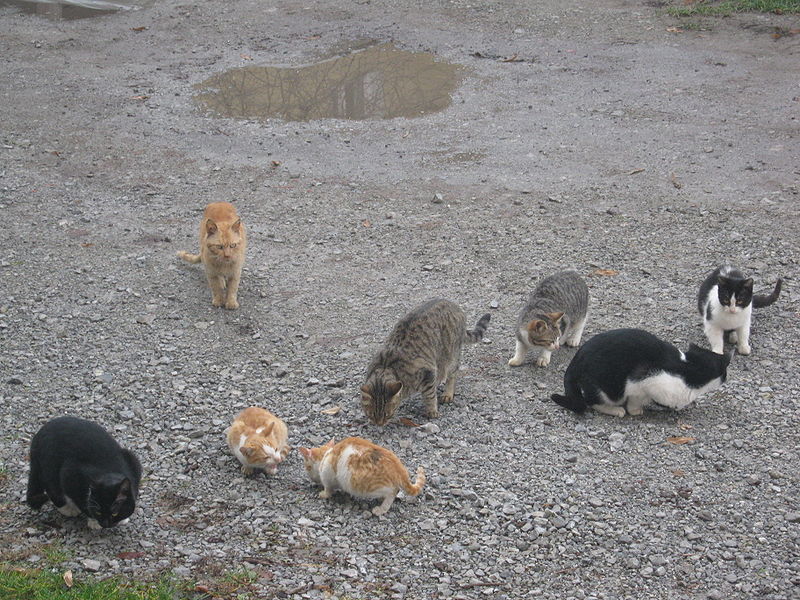
This orange cat seems to have a pretty good life, which is often true for cats living in colonies that are managed. This colony, as I’ve said, is at least getting fed regularly. However, his life is liable to be shorter than that of an owned cat, and in fact I have already taken two badly-injured community cats the local veterinary hospital for euthanasia. (As the neighborhood veterinary student I find that one of my responsibilities is dealing with cats who have been hit by cars or attacked by other animals.) He is also at risk of disease, such as feline leukemia or feline AIDS, because he has probably never been vaccinated. He is not the only one at risk; his colony may maintain a reservoir of these feline diseases which can then be transmitted into the population of owned cats who are allowed outside to interact with their feral cousins. Moreover, community cats are often sexually intact and certainly contribute to the overwhelming number of kittens that my community sees every spring and summer. And, of course, bird lovers complain of the depredations of community cats on the local wildlife.
Time was, people trapped community cats and euthanized them as a means of population control. This didn’t work as well as you might think, because when a colony of cats was depleted, new cats would move in to take their place. It turns out that maintaining a healthy colony keeps new cats out. In the last decade or so, volunteers and animal shelters have been implementing trap/neuter/return (TNR) programs. Cats are trapped and brought to veterinary clinics, where they are vaccinated and spayed or neutered. They are returned to their colonies, which are managed by caretakers. In this way, colonies are kept small but healthy.
However, TNR programs are maintained at great expense. Veterinary surgeons are not cheap, and even with volunteer veterinarians, a surgical suite also has to be acquired. Cats have to be trapped on a specific day when a TNR clinic is scheduled, not an easy task itself, transported to the clinic and then transported back. The expense slows down the process, and it’s not clear that we can spay and neuter fast enough to keep up with the population.
A simple medical intervention would be much more efficient than surgery. The ideal chemical contraceptive would be inexpensive to make and easy to administer; a single treatment would have a long term or even permanent effect; it would have a wide margin of safety for both cats and the environment (you wouldn’t want a dead cat to be full of some toxin that would endanger other animals); and it would have a rapid onset of action. Ideally, it would not just prevent litters, but would also reduce the nuisance behaviors associated with breeding, because cats having sex are extremely noisy. The contraceptive should be widely effective, although studies suggest that it only needs to affect 70-80% of female cats in order to achieve population reduction.
There are some possibilities already being studied. Both are vaccines – it’s an amusing idea to vaccinate against pregnancy, but of course vaccines do have a long term effect, so they're logical choices for this situation. One vaccination target is the zona pellucida. This is the coating around the egg which allows in one, and only one, sperm; vaccinated animals produce antibodies which attack the ZP and therefore inactivate the egg. The nice thing about ZP vaccination is that is is highly species-specific – the ZP is, in fact, part of the mechanism that keeps species from being able to interbreed with each other. Unfortunately, the ZP vaccine which is currently available was not developed specifically against cat ZP, and does not work well in cats. A cat-specific ZP has also been tested but, surprisingly, is not highly effective either. Perhaps more research will sort the problem out, but for now this is not a viable alternative. Additionally, as you might guess from the mechanism, ZP vaccination doesn’t affect mating behaviors even when it works; it only affects conception. So cats will still yowl during sex after ZP vaccination.
A more promising alternative is vaccination against GnRH, the master hormone of the sex hormones. Through minion hormones, GnRH controls production of sperm and ovulation of eggs. Unlike the ZP vaccine, the GnRH vaccine reduces both pregnancy and mating behaviors. Its effectiveness is somewhat unpredictable, so some vaccinated animals keep right on getting pregnant. Its length of effectiveness is also somewhat variable, but can last up to several years in some studies. Although your housecat might live into its late teens, several years of birth control are probably sufficient in shorter-lived community cats.
A commerical GnRH vaccine, GonaCon, is approved in cervids and has been successfully used in white-tailed deer. It has been tested in cats in laboratory settings, but not in the field. The idea is enticing: volunteers could trap cats, then vaccinate them with GonaCon and the usual array of anti-disease vaccines right in the trap, then release them, never having had to bring them in to a veterinary clinic. Efficiency would be hugely increased. Hopefully initial trials would show that GonaCon is effective at population reduction in cats, something that hasn’t yet been proven.
Real life is never so simple, of course. I talked about contraceptive vaccination with a few vet techs at an animal shelter recently. They loved the idea, but pointed out that in our state, once you are providing any medical care for a cat, such as contraception, you have to make sure they are vaccinated for rabies, which legally requires the presence of a veterinarian. Once you have to bring in a vet, of course, the expense starts going up again. We batted around some ideas – maybe you could distribute an oral form of a vaccine in bait form, and get around the rabies vaccination requirement by dint of never actually touching the cat. In this case, the ZP vaccine might be better, as it is more species-specific and presumably could be eaten by other species without effect, but of course the ZP vaccine requires more work before it will be effective in cats.
So chemical contraceptives for community cats aren’t quite ready for prime time, but there are some promising candidates. My suspicion is that the biggest problem is simply willingness on the part of society to commit the resources necessary to develop a workable solution. Cat rescuers and animal shelters, both with notorious money problems, can’t possibly represent attractive markets to drug companies. Who will fund the necessary research and the advocacy for policy changes that are necessary? You can stay up to date with news as the story unfolds at the Alliance for Contraception in Cats and Dogs. You can even donate to them. Community cats may be our responsibility, as domesticated animals gone feral, or they may not be, but either way they affect us and the animals we live with. Efficient and humane management of their populations benefits both them and us.
References
- Levy, J.K. (2011). Contraceptive Vaccines for the Humane Control of Community Cat Populations, American Journal of Reproductive Immunology, 66 (1) 70. DOI: 10.1111/j.1600-0897.2011.01005.x
- Levy, J.K., Friary, J.A., Miller, L.A., Tucker, S.J. & Fagerstone, K.A. (2011). Long-term fertility control in female cats with GonaCon™, a GnRH immunocontraceptive, Theriogenology, 76 (8) 1525. DOI: 10.1016/j.theriogenology.2011.06.022
- Alliance for Contraception in Cats and Dogs
Sunday, April 22, 2012
Book Review: Plenty in Life is Free
I just finished Plenty in Life is Free: reflections on dogs, training and finding grace, by Kathy Sdao. It was revelatory. It is funny to say that I had trouble putting down a dog training book, but I did (I put off email and sleep to finish it). It’s a short book, but truly lovely. The two Sdao seminars I’ve attended have both stuck with me years later and informed my training, and Sdao is as engaging and thoughtful an author as she is a speaker.
This book seems to be written for an audience of dog trainers, but it has plenty in it to appeal to the dog owner as well. Don’t expect it to walk you through how to train your dog to sit, or to provide details on how to handle a new puppy or to turn around dog-dog aggression. It’s really a philosophy book about how to approach dog training: we don’t have to control our dog’s every move and obsess about leadership. We can be our dog’s parents, protecting and guiding but leaving them a reasonable amount of independence too.
Sdao discusses the concept of “sticky stories,” stories that stick in people’s minds, such as the story that dogs evolved from wolves and therefore a good dog owner acts like the alpha wolf. She provides an alternate version of a story that is more accurate and hopefully just as sticky: dogs evolved from scavengers and we should be their parents, doling out resources as good parents do. I like her proactive approach; let’s hope that the new, improved sticky story takes root.
Sdao also constructs a sticky meme in the same vein as Michael Pollan’s famous advice about how to eat (“Eat food, not too much, mostly plants”). Hers goes “Reinforce behaviors you like; remove reinforcement for behaviors you don’t like.” She correctly identifies that, while pithy, this is probably not catchy enough to be sticky, and goes on to describe a SMART (see, mark, and reward training) system, in which you train your dog by doing little more than rewarding the dog 50 times a day for doing cute or useful things. (I may be oversimplifying, but not by much; the point is that it’s simple.)
It’s a short, fun, useful read. I cannot recommend this book highly enough. Available at Dogwise.
Subscribe to:
Posts (Atom)

